Interactive
Drain teardown simulator
Four layers, in the order you meet them. Drag to rotate, explode to separate, click a layer to read what it does and how it comes out. Everything is generated in the browser — no models are downloaded.
Loading the 3D model…
The 3D view could not start.
Your browser may not support WebGL, or the model failed to load.
This is an educational simulation of a typical floor drain, not a survey of yours. Actual fittings vary — follow the manufacturer's instructions and local plumbing rules.
2D exploded diagram
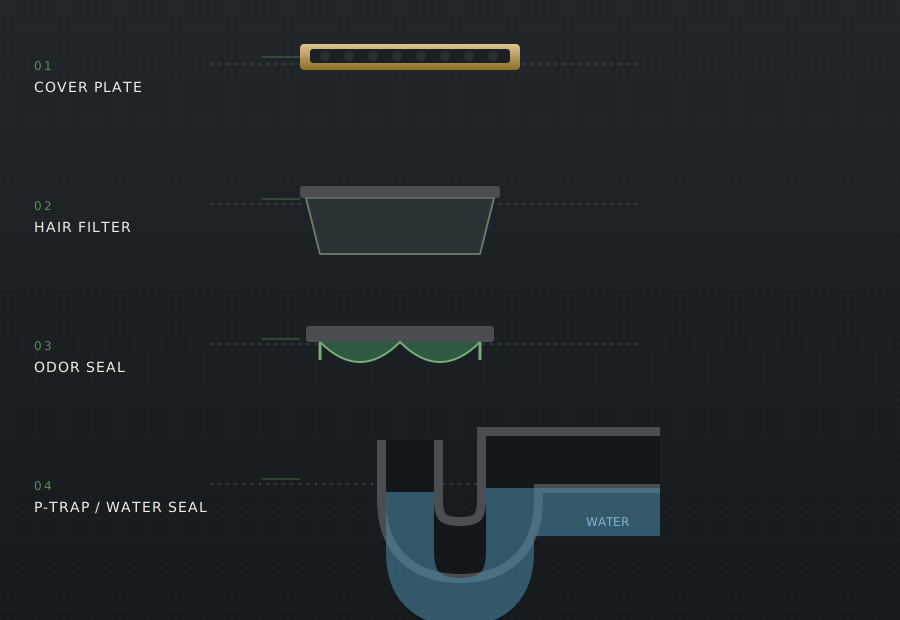
01 · Cover Plate
Holds your weight and keeps large debris out of the pipe. It is also the only layer you touch on a normal day.
Remove: Lift it straight up. Most are loose in the recess — no screws, no tools.
02 · Hair Filter
Traps hair and lint before they reach the seal. This is where 90% of slow drains start.
Remove: Twist counter-clockwise, then lift. Some push-fit models just pull out.
03 · Odor Seal
A silicone or rubber membrane that opens for water and closes against air. When it perishes, the room smells even though the drain runs perfectly.
Remove: Pull the insert out of the bore by its rim. Note which way the flap faces.
04 · P-Trap / Water Seal
A permanent water barrier between the room and the soil pipe. Water sits in the dip and blocks gas. If it dries out, gas walks straight up.
Remove: Not normally removable. Access is through the trap plug or by cutting the arm.
Next step
See the four layers move.
The teardown simulator pulls a floor drain apart, layer by layer, so you know exactly what you are reaching for before you reach for it.