Diagnose
Four faults. One of them is yours.
Every floor-drain complaint resolves to one of these four. The symptom tells you which, and the symptom also tells you which tool to pick up — or whether to pick up the phone instead.
WEAR GLOVES · VENTILATE · DON'T MIX CHEMICALSOpen a window. One product at a time. Never reach into a drain you cannot see the bottom of.
| Type | What you notice | Usual cause | DIY difficulty |
|---|---|---|---|
| Smell Only | Sewer or rotten-egg smell rising from the grate. Flow is normal, no standing water. | Evaporated water seal (unused drain, holiday, spare bathroom) | EASY |
| Slow Drain | The shower tray fills ankle-deep while you wash, then drains slowly once you stop. | Hair wrapped around the stopper or filter basket | EASY |
| Standing Water | A permanent pool in the tray or on the floor. Plunging changes the level but it settles back. | Hard blockage in the trap arm (soap, hair, sanitary product) | MEDIUM |
| Gurgling | A hollow gulp from the floor drain seconds after a toilet flush or a washing machine empties. | Blocked or frozen vent pipe | MEDIUM |
Type 1 of 4
Smell Only
It reeks, but the water still goes down at full speed.
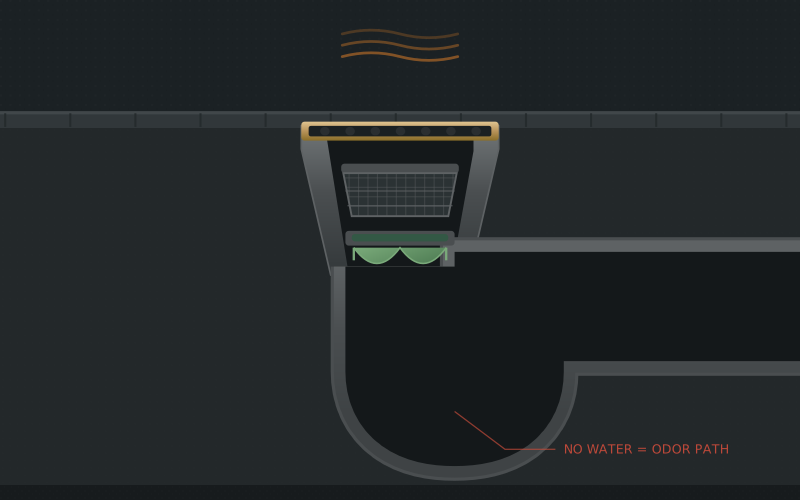
Why it happens
The clog is not the problem — the seal is. A dry water seal, a perished rubber flap or a missing one-way valve leaves a direct air path from the soil pipe into the room.
Checks, in order
- Pour a cup of water down the drain. Smell gone = dry trap.
- Smell returns within a day = the seal is broken, not just dry.
- Look under the cover: is there a silicone flap, a rubber membrane or a water cup?
- Check whether the drain is used at all. Guest bathrooms dry out in 2–4 weeks.
Common causes
- Evaporated water seal (unused drain, holiday, spare bathroom)
- Perished or inverted silicone flap
- Missing one-way valve after a renovation
- Wax ring or gasket failure where the drain meets the tile
Type 2 of 4
Slow Drain
Water pools for a few seconds, then gurgles away.
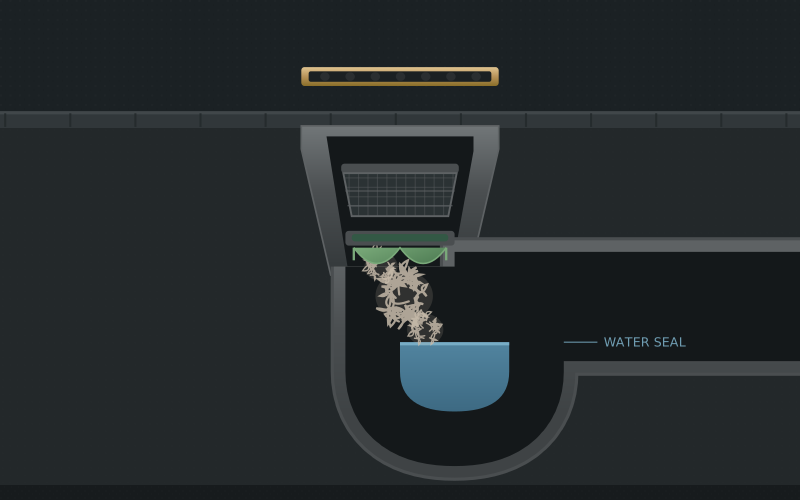
Why it happens
Something is physically restricting the bore. In a shower drain that is hair and soap scum nine times out of ten — the hair wraps the stopper and the scum cements it in place.
Checks, in order
- Lift the cover and look at the stopper and the first 100 mm of pipe.
- A hair mat looks like a grey felt ring around the filter basket.
- If the water drains fine when the cover is off, the cover slots are blocked.
- Chemical cleaner that "flows straight through" means the blockage is solid, not grease.
Common causes
- Hair wrapped around the stopper or filter basket
- Soap scum and body oil cemented onto the pipe wall
- Sand, grout or tile adhesive from a recent renovation
- A partially closed or furred-up trap arm
Type 3 of 4
Standing Water
The water does not move at all — it just sits there.
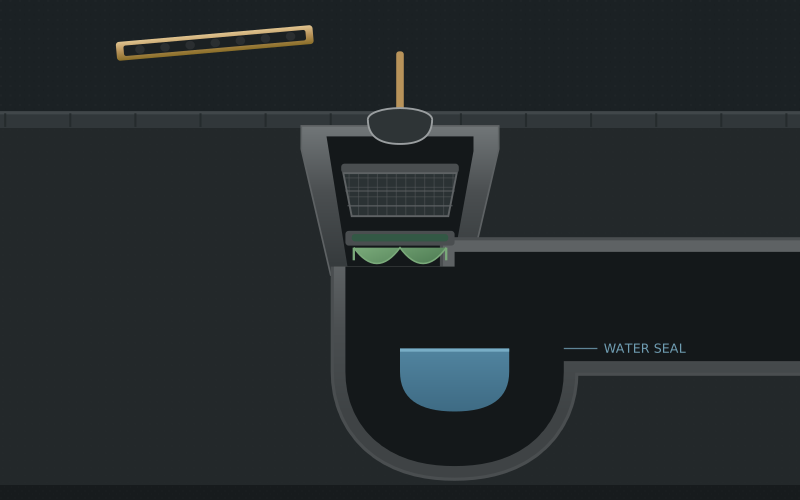
Why it happens
The blockage is past the trap, in the trap arm or the branch line. Water above it cannot move because the air below cannot escape and the blockage will not pass.
Checks, in order
- Plunge once. If the level rises and falls, the blockage is close and soft.
- If plunging does nothing at all, the blockage is hard or further down the branch.
- Check a second drain nearby. Two slow drains = main line, call a plumber.
- Smell at the overflow or a gurgle in the sink means the branch is shared.
Common causes
- Hard blockage in the trap arm (soap, hair, sanitary product)
- Blocked or partially collapsed branch line
- Blocked vent causing air lock
- Root intrusion in an older clay or cast-iron line
Type 4 of 4
Gurgling
It burps and bubbles, especially when the toilet flushes.
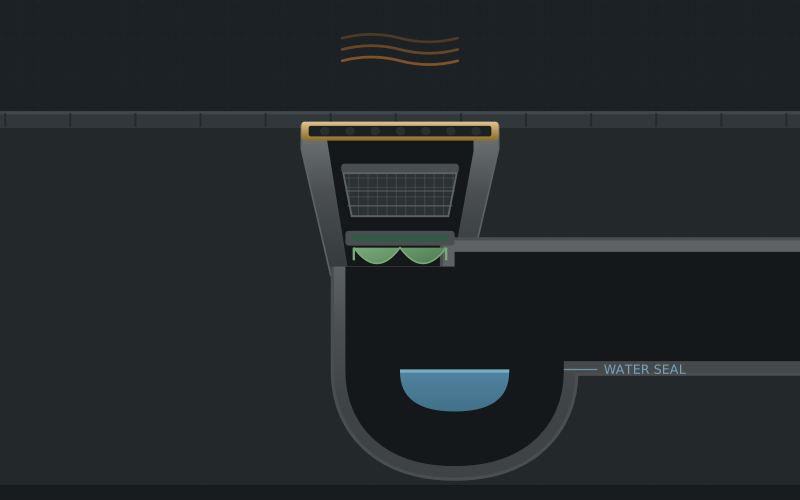
Why it happens
Air is being pulled through the drain because the vent is blocked or undersized. The gulp is the water seal being siphoned out — which is why the smell usually follows a day later.
Checks, in order
- Flush a toilet and watch the floor drain. Bubbles = siphonage.
- Smell right after the flush confirms the seal has been pulled.
- Look for a blocked air admittance valve under the sink nearby.
- On a top floor, check the roof vent for nests or snow.
Common causes
- Blocked or frozen vent pipe
- No vent at all on a renovated branch
- Undersized trap for the fixture load
- Shared trap between two fixtures
Next step
See the four layers move.
The teardown simulator pulls a floor drain apart, layer by layer, so you know exactly what you are reaching for before you reach for it.